

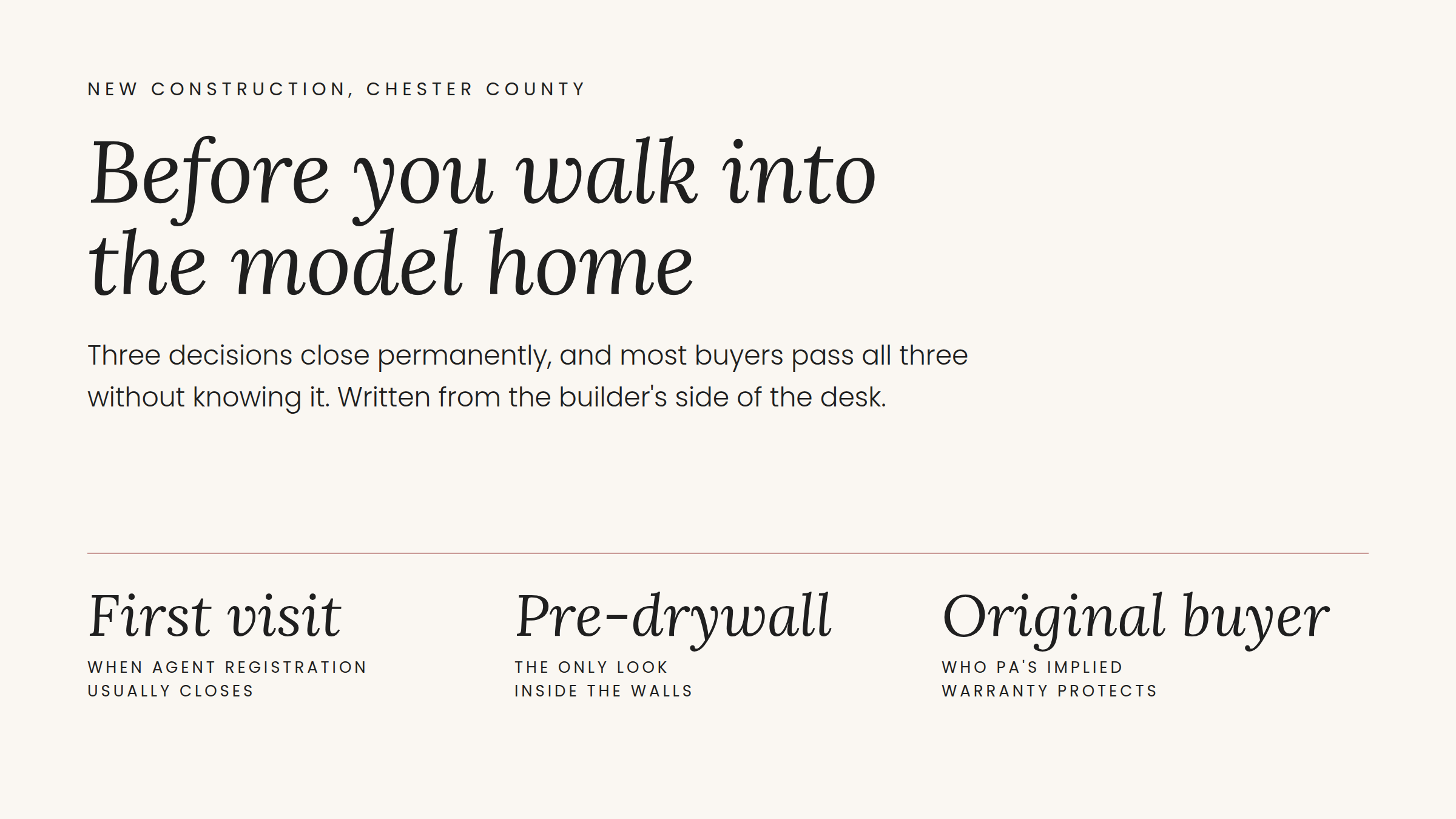
Here is the thing almost nobody tells you. The moment you walk into a model home and sign the visitor card, you may have just decided whether you get to have your own agent on that purchase. Not in a month, not at the contract. That day.
I know this because I used to be the person handing you the clipboard. All three of us came out of new home sales on the builder’s side before we moved to resale, so this article is less a list of tips and more a walk through what is actually happening on the other side of that desk.
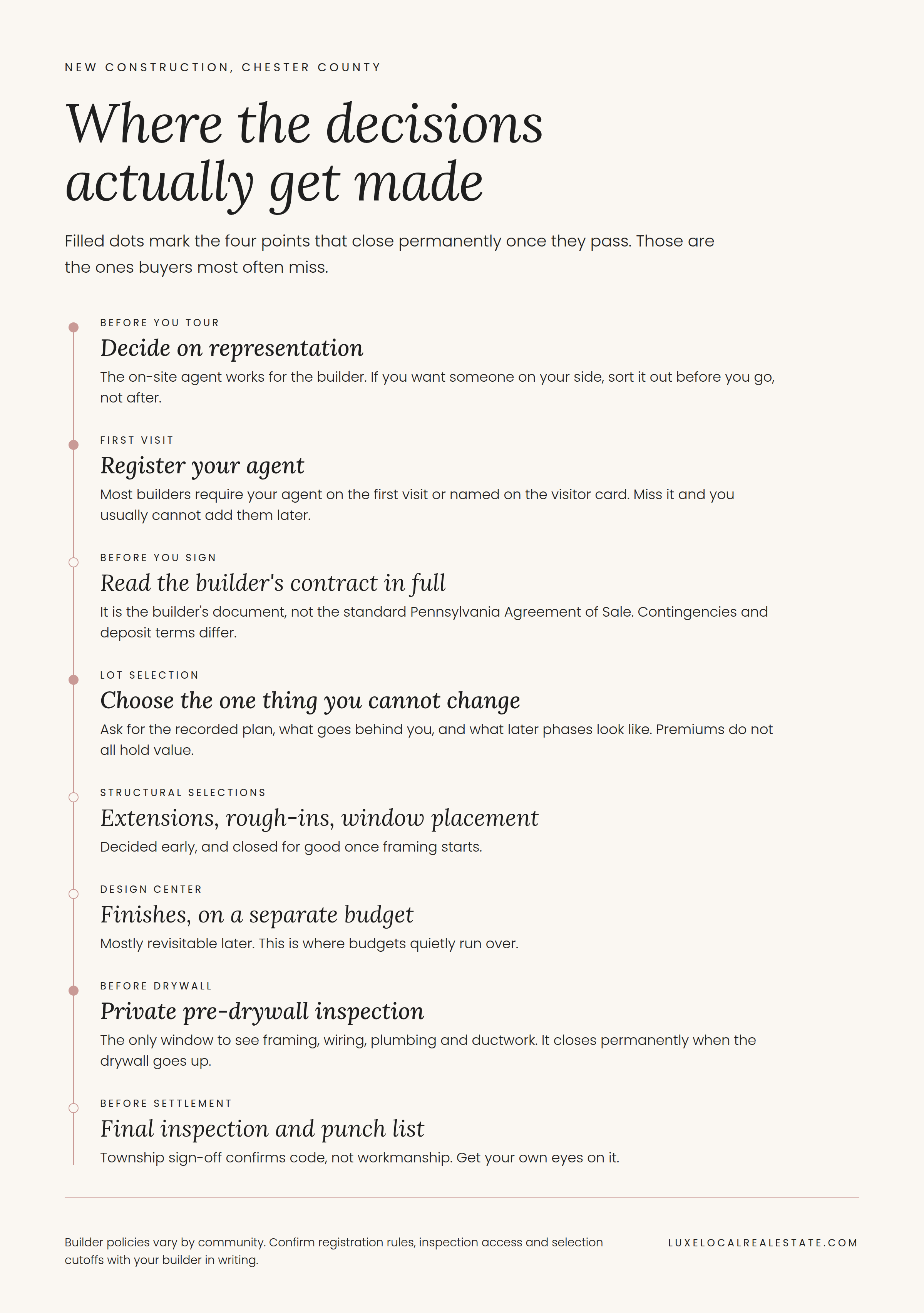
Start here: who the on-site agent works for
The person in the model home is good at their job. They know their product cold, they will answer every question honestly, and they are not trying to trick you.
They also work for the builder.
That is not a criticism, it is just the arrangement. Their job is to sell the builder’s homes on the builder’s terms, and they represent the builder’s interests in the negotiation. If you walk in without your own representation, nobody in that room is working for you.
Plenty of people buy new construction unrepresented and do fine. But you should make that choice knowingly rather than discover it at the contract table. If you want to know how we work with buyers, that page covers it.
The registration rule, and the most expensive mistake buyers make
Most builders require that your agent be with you, or be named by you, on your first visit to the community. Miss that and many builders will not recognize your agent on that purchase at all, which means you cannot bring them in later when things get complicated.
It happens constantly. A couple drives past a sign on a Sunday, tours on a whim, falls in love, and calls their agent Monday morning. By then the builder’s policy has already answered the question.
So if there is any chance you want your own representation, bring your agent the first time or name them on the visitor card before you tour. It costs you nothing to keep the option open, and it is not recoverable once it is gone.
Who pays your agent, and why you need to ask up front
The rules here changed in 2024. Your agent must have a written agreement with you before touring a home with you, and that agreement has to spell out how they are compensated. Compensation is negotiable and is not set by law.
What that means practically in new construction: some builders offer to pay a buyer agent’s compensation, some offer a reduced amount, and some offer nothing and expect you to cover it. It varies by builder and sometimes by community. The answer is knowable, it is just not usually volunteered.
Ask before you tour. Ask the builder’s representative directly what they offer a buyer agent, and have your agent tell you plainly what they charge and what happens if the builder pays less than that. A good agent will give you a straight answer.
The contract is the builder’s, not Pennsylvania’s standard one
On a resale, you are working from the Pennsylvania Association of Realtors Agreement of Sale, which is a known quantity with inspection contingencies, a mortgage contingency and a clear deposit framework.
Builders use their own contract. It is written by the builder’s attorney, for the builder, and it tends to differ from the standard form in ways that matter:
- Fewer or narrower contingencies
- Language letting the builder adjust specifications, materials or the delivery date
- Limits on what happens if the home is late
- Arbitration or dispute-resolution clauses
- Deposit terms that are considerably less forgiving
Read it slowly, and do not let anyone rush you through it. The three sections worth your full attention are the contingencies, the builder’s right to change specifications or the delivery date, and what happens to your deposit. If any of it is unclear, ask the builder’s representative to explain it and get the answer in writing.
Deposits work differently
Expect a larger deposit than on a resale, often taken in stages. Initial deposit at signing, then more as you make structural selections and again at the design center.
The part that surprises people is what happens if you walk. On a resale, deposit disputes run through the Agreement of Sale, and in Pennsylvania courts have been clear that the agreement controls. On a builder contract, the terms may allow the builder to keep more of what you have put down, particularly once they have started building to your selections. Read that section specifically, and ask what happens at each stage: before construction starts, after structural selections, and after the design center. The answers should be in the contract, not just in conversation.
The lot is the only thing you can never change
You can repaint. You can replace the counters in ten years. You cannot move the house.
Lot premiums in Chester County can run into real money for a walkout basement, a cul-de-sac position, trees behind you, or a lot that backs to preserved open space rather than the next phase of the same community. Some of those premiums hold their value at resale and some evaporate.
Things worth knowing before you pick:
- What is going on the lots behind and beside you, and in later phases
- Whether your yard is usable or mostly slope
- Where the stormwater basin, utility easements and sidewalks land
- Sun orientation, which decides whether that back deck is pleasant in July
- Whether the lot supports a walkout, and what that does to the basement’s future value
Ask for the recorded plan, not just the glossy site map. Those are different documents. It is also worth knowing which municipality you are actually buying in, because new construction buyers run into the same borough-versus-township confusion as everyone else here, and it changes your taxes and your school district.
The design center: structural first, pretty later
This is where budgets go sideways. You sit down in a beautiful showroom, everything looks great, and the numbers climb a few thousand at a time until you are well past where you meant to be.
The discipline that helps: separate structural from cosmetic.
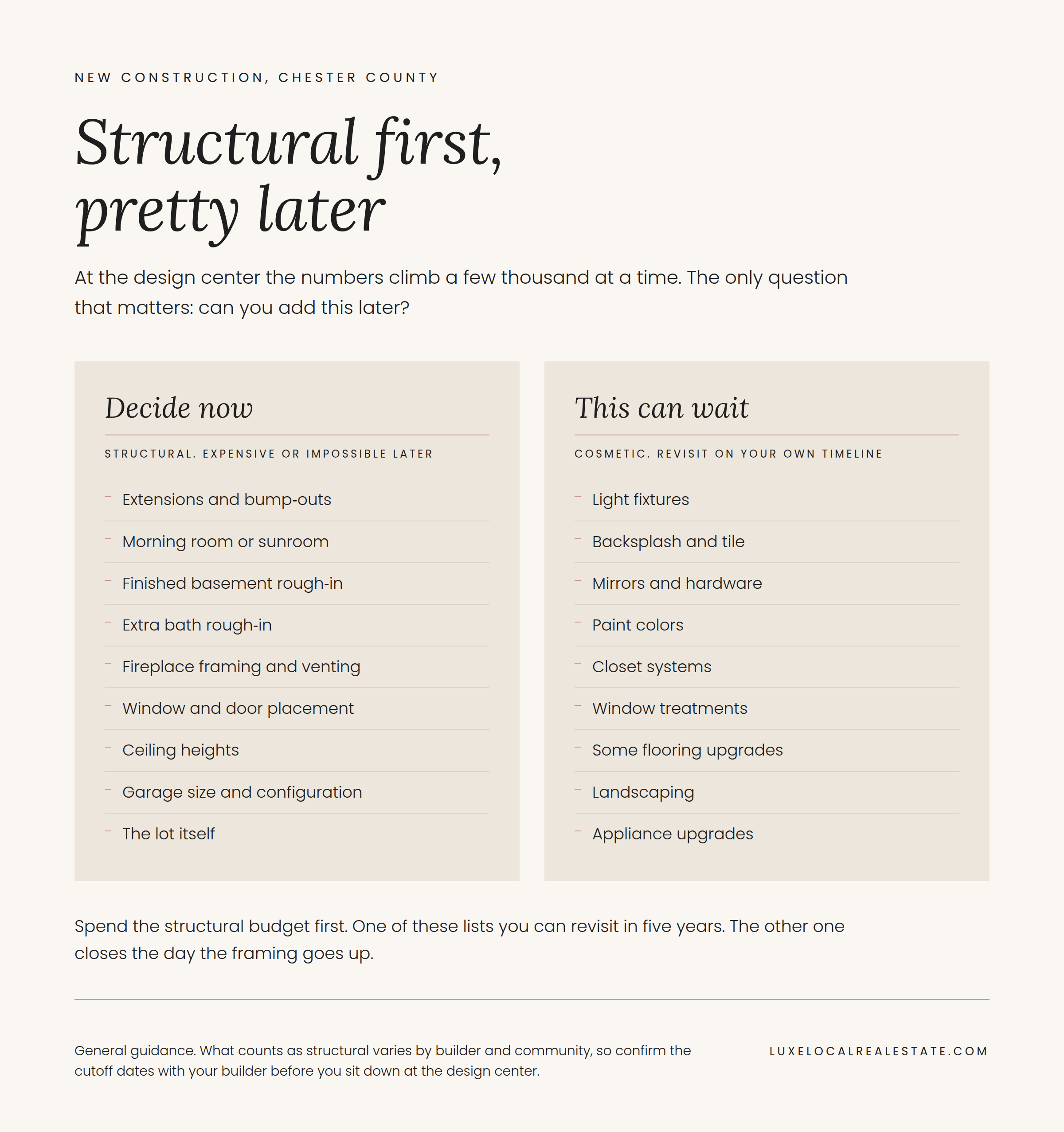
Structural has to be decided now and is expensive or impossible to add later. Extensions, a morning room, a finished basement rough-in, an extra bath rough-in, fireplace framing, window and door placement, ceiling heights, garage configuration.
Cosmetic can usually wait. Light fixtures, backsplash, mirrors, paint, closet systems, sometimes flooring. The builder will mark these up and install them to a schedule. You can often do better later on your own timeline.
My rule of thumb is to spend the structural budget first and the pretty budget last, because one of them you can revisit and the other you cannot.
The builder’s lender, and the incentive attached to it
Most builders have an affiliated lender, and most tie an incentive to using them, often several thousand toward closing costs. A builder can incentivize you to use their lender. They cannot require it.
Take the incentive seriously, it is real money. Then get at least one competing quote and compare the whole picture: rate, points, lender fees, and the incentive. Sometimes the builder’s lender genuinely wins. Sometimes the incentive is smaller than what the rate difference costs you over the first few years. You will not know which without the second quote.
Yes, you should still inspect a new house
Buyers skip this constantly. A new home passed township inspections, so why pay for your own?
Because township inspections confirm code compliance, not workmanship, and because the people building your home are human. I have seen missing insulation, ductwork run wrong, framing issues and drainage problems on brand new houses.
Two inspections are worth it:
- Pre-drywall, while framing, wiring, plumbing and ductwork are still visible. This is the only window you get, and once drywall goes up it closes permanently.
- Final, before settlement, which produces your punch list.
Confirm the builder allows a private inspector and what notice they need. Most do. The ones that resist are telling you something.
The warranty, and a Pennsylvania wrinkle worth knowing
Most builders offer some version of a 1-2-10: roughly one year on workmanship, two on systems like plumbing, electrical and HVAC, and ten on major structural defects. Read the actual document, because coverage and the claim process vary a lot between builders.
Underneath that, Pennsylvania recognizes an implied warranty of habitability on new homes, which comes from a 1972 case called Elderkin v. Gaster rather than from a statute.
Here is the part worth knowing: in Conway v. Cutler Group, the Pennsylvania Supreme Court held that this implied warranty protects the original purchaser and does not extend to a later buyer. The court said extending it is a question for the legislature.
Practically, that means a three-year-old house bought from its first owner is a different legal situation than the same house bought new from the builder. It is a reason to take resale inspections on newer homes seriously, and a genuine point in favor of being the first owner.
Who is building in Chester County right now
The county has an unusual mix. National builders are active alongside regional and custom builders, and because buildable land here is tight, a lot of what gets built is infill, small subdivisions and build-on-your-lot rather than 300-home developments.
Builders currently active in the county include Toll Brothers, NVHomes, Ryan Homes, Pulte, Lennar, D.R. Horton, K. Hovnanian, Rouse Chamberlin, Keystone Custom Homes, Eddy Homes, Hellings Builders, Bentley Homes, Cedar Knoll Builders, Montchanin Builders, Berks Homes, FoxLane Homes, Renehan Building Group, Glenn M. White and Traditions of America. Communities are concentrated around Downingtown, Exton, Malvern, West Chester, Kennett Square, Coatesville, Glenmoore, Phoenixville, Spring City, Oxford and West Grove. You can see more on our Chester County communities page.
That range matters when you shop. A national builder’s process, contract and design center work very differently from a local custom builder’s, and the right fit depends on how much you want to control versus how much you want handled.
We also represent builders directly, so we see this from both sides and know which communities are moving and which are quietly negotiating. The new construction communities we represent are listed here.
Before you go to the model home this weekend
If you are heading out to tour, do these four things first. They take an hour and they are the whole ballgame.
- Decide whether you want your own representation, and if so, bring them or name them on your first visit.
- Ask what the builder offers toward a buyer agent, and get your own agreement in writing.
- Read the builder’s contract in full before you sign, especially the deposit and contingency sections.
- Set your structural budget separately from your finishes budget.
If you are weighing a few communities and want to know which builder actually negotiates, which lots are worth the premium, and what the contract does not say out loud, that is the conversation we are built for. We have sold new homes from the builder’s side and represented buyers across the table from it, and it is a very different experience when someone in the room has done both.
Frequently asked questions
Do I need a real estate agent to buy new construction in Chester County?
You are not required to have one. The thing to understand is that the on-site agent at the model home represents the builder, so without your own agent, nobody in the transaction represents you. If you do want representation, bring your agent on your first visit to the community or name them on the visitor card. Most builders will not recognize an agent introduced after that first visit.
Who pays the buyer’s agent on new construction?
It depends on the builder. Since 2024, your agent must have a written agreement with you before touring, and that agreement states their compensation, which is negotiable and not set by law. Some builders offer to pay a buyer agent, some offer a reduced amount, and some offer nothing. Ask the builder’s representative directly before you tour, and make sure your own agreement says what happens if the builder pays less than your agent’s fee.
Is a builder’s contract the same as the Pennsylvania Agreement of Sale?
No. Resales typically use the Pennsylvania Association of Realtors Agreement of Sale. Builders use their own contract, and it usually has narrower contingencies, more flexibility for the builder on specifications and timing, and stricter deposit terms. Read it in full before signing, paying particular attention to the deposit terms and to what the builder is allowed to change.
Should I get a home inspection on a brand new house?
Yes. Township inspections check code compliance, not workmanship. A pre-drywall inspection, while framing, wiring and ductwork are still exposed, is the only chance to see inside the walls, and a final inspection before settlement produces your punch list. Confirm with the builder that a private inspector is permitted and what notice they need.
How long is a new home warranty in Pennsylvania?
Most builders provide a warranty along the lines of one year on workmanship, two years on systems and ten years on major structural defects, though the specific document controls. Pennsylvania also recognizes an implied warranty of habitability on new homes from case law rather than statute. In Conway v. Cutler Group, the Pennsylvania Supreme Court held that this implied warranty protects the original purchaser and does not extend to later buyers.
Are lot premiums in new construction worth it?
Sometimes. A premium for a walkout basement, a position backing to preserved open space, or a cul-de-sac lot often holds value at resale. A premium for a lot that simply faces a nicer direction within the same community often does not. Ask what is planned for the lots around you and for later phases, and ask for the recorded plan rather than the marketing site map.