

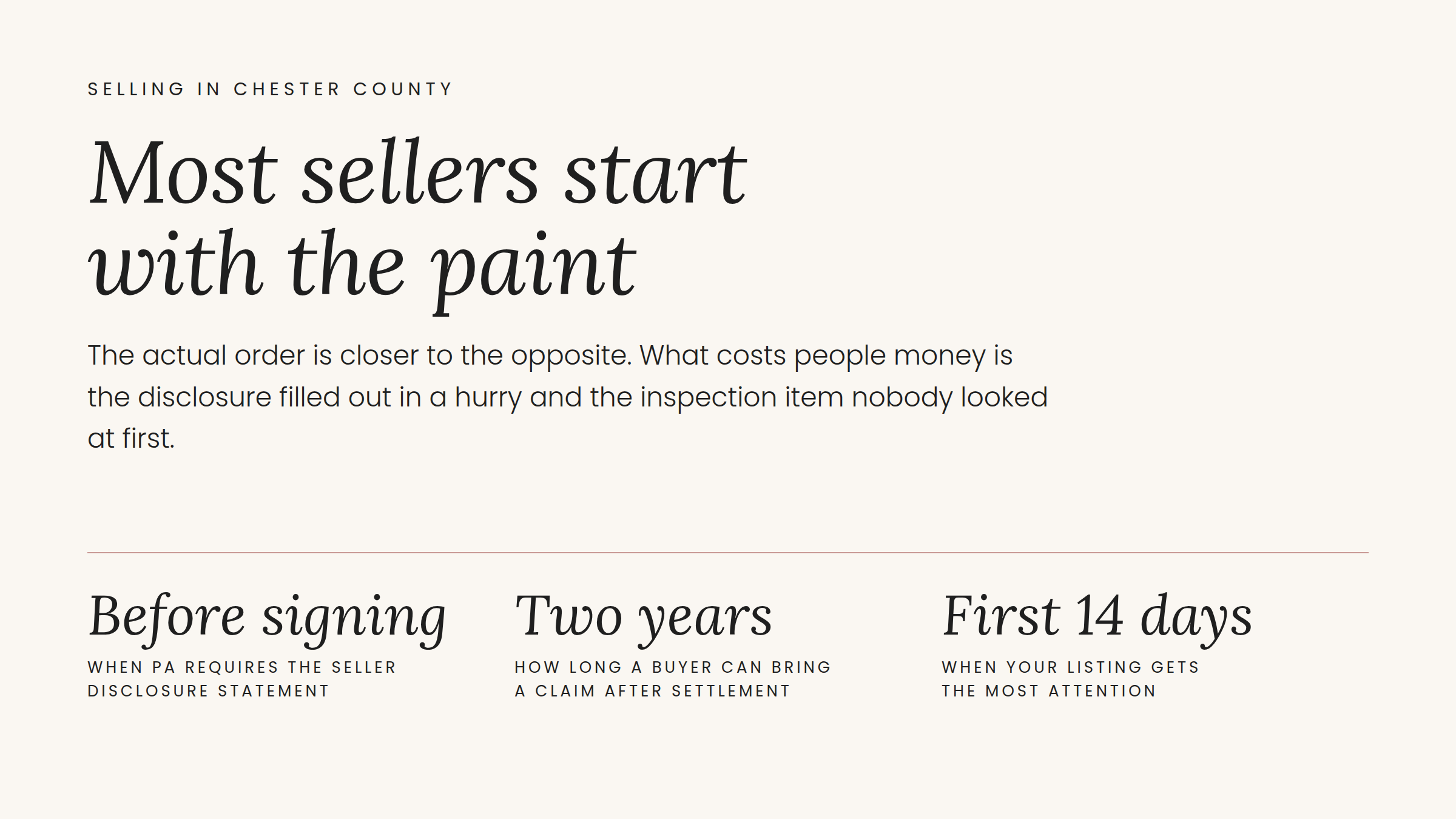
Most sellers start with the paint. The actual order is closer to the opposite.
The document that causes the most trouble for Pennsylvania sellers is the one people tend to fill out in ten minutes at the kitchen table. The repairs that blow up deals are almost always the ones nobody looked at until a buyer’s inspector did. And the money that gets spent on a pre-listing renovation often would have done more work sitting in the price.
Here is the sequence I would actually follow.
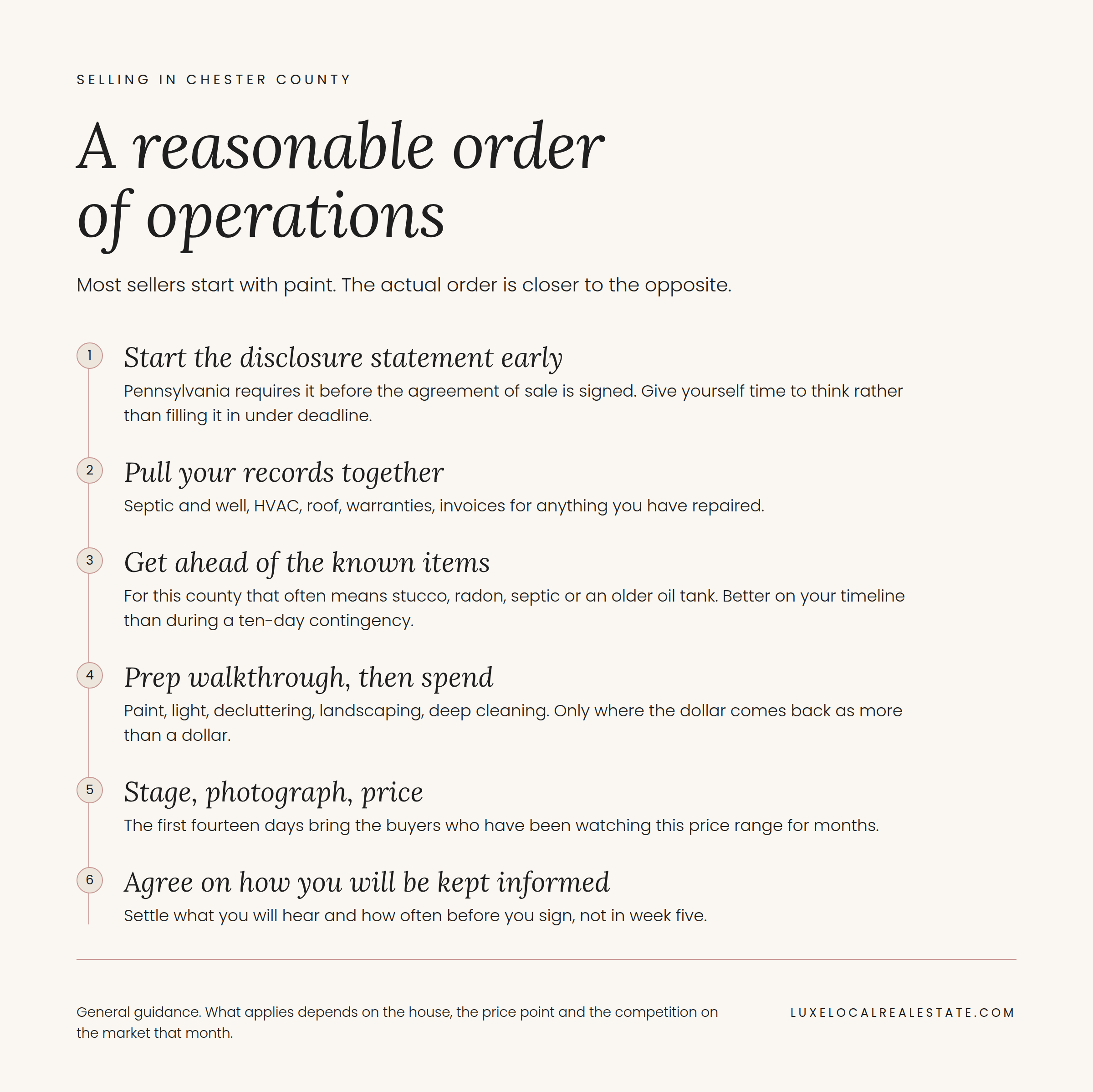
Step one: the disclosure statement is a legal document, not paperwork
Pennsylvania’s Real Estate Seller Disclosure Law requires you to give the buyer a signed property disclosure statement on the State Real Estate Commission’s form, and to do it before you and the buyer sign the agreement of sale. Not at settlement. Before.
A few things sellers routinely get wrong about it:
- You are not required to go investigate. The law does not make you hire anyone or open walls. You disclose what you know.
- You are required not to conceal. You cannot make a statement you know to be false or misleading, and you cannot fail to disclose a known material defect. A material defect is one that would significantly affect the property’s value or pose an unreasonable risk to people.
- Age is not automatically a defect. A twenty-two-year-old roof is not a material defect just because it is near the end of its life.
- If something changes, you have to say so. If the disclosure becomes inaccurate before final settlement, you are required to tell the buyer.
- The window stays open after you close. A buyer has two years from final settlement to bring a claim for damages under this law.
This is a description of how the law works, not legal advice. The practical version is simpler: write down everything you know, including the things you would rather not mention. The repair you disclosed is a negotiation. The repair you hid is a lawsuit.
Start it early, while you have time to think about it, rather than filling it in the week an offer lands.
Step two: the things that come up on Chester County inspections
Every market has its recurring findings. Here are the ones that show up again and again in this county, and all of them are better handled on your timeline than during a ten-day inspection contingency.
Stucco. If your home was built roughly between the late 1980s and the mid 2000s and has stucco or EIFS, buyers in this market know to ask about it, and many will want a moisture test. Whatever the result, you want to know it before a buyer’s inspector tells you.
Radon. Pennsylvania has one of the most serious radon problems in the country, and about 40 percent of homes tested statewide come back above the EPA’s action level of 4 picocuries per liter. Mitigation is a known, solvable, relatively modest job. An unexpected radon result two weeks before settlement is a much bigger problem than a mitigation system you installed in advance.
Wells and septic. If you are in the western or southern townships, you are likely on well, septic, or both. Buyers will want testing. Find your system records and your last pumping date now, because locating a septic tank lid in February is nobody’s idea of a good time.
Oil tanks. Older homes here sometimes have a buried or abandoned tank. If you have one, or you think you might, get ahead of it.
While you are at it, pull your records together in one place: septic and well, HVAC, roof, any warranties, and invoices for anything you have repaired. Documentation is what turns a scary-sounding inspection line into a solved problem.
Step three: prep that actually changes the number
We do a prep walkthrough on every listing before it goes to market, and the honest finding most of the time is that sellers are prepared to spend money on the wrong things. You can see more about how we prepare a listing on our sellers page.
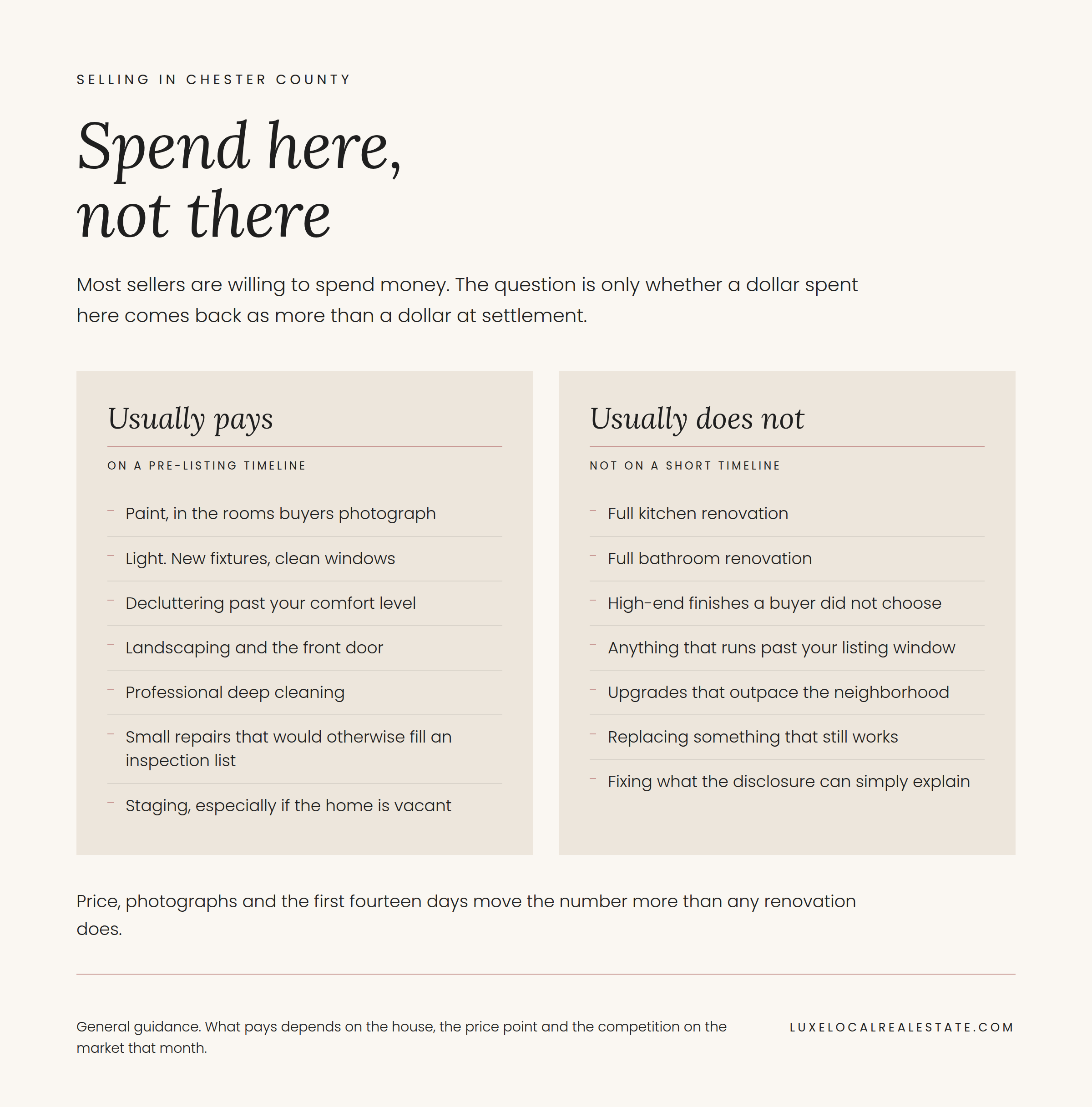
The question I ask at every walkthrough is whether a dollar spent here comes back as more than a dollar at the closing table. Most of the time the answer points at paint, light and decluttering, not at a renovation.
Step four: staging, honestly
Staging works, and it works hardest on vacant homes and on anything competing with new construction. Buyers at the upper end tour builder model homes with designer furniture in them, and an empty room next to that comparison does not win.
We offer staging with our listings. Our standard agreement covers the initial staging plus 60 days of furniture and decor rental, and then it is $500 a month after that. I mention the structure because it is the part sellers never get told up front, and because a staging plan that runs past 60 days should be a conversation about price, not a bigger rental bill. Our sold listings will give you a sense of how the staged ones photograph.
Step five: pricing, and why the first two weeks decide everything
Your listing gets the most attention in its first 14 days. That is when the buyers who have been watching this price range for months see it. After 30 days, new buyers start wondering what is wrong with it.
The rough framework I use, as guidelines rather than rules:
- Almost no showings usually means the price is roughly 10 percent above where buyers see the value
- Steady showings but no offers after about two weeks usually means roughly 5 percent above
- Showings and offers means the price is right and the work is in the negotiation
A caveat I will always say out loud: a home not selling is not automatically a pricing problem. It can be photos, access, condition, a specific objection that keeps coming up in feedback, or a buyer pool that needs a different kind of marketing. The right response is to look at what the feedback is actually telling you before anybody touches the price. If you want a starting point, here is what your home is worth right now.
Step six: decide what you want to hear from your agent, and how often
This is the part sellers do not know to ask about, so I will say it plainly. Every Monday I review each of our active listings, the showing activity, the feedback, how the listing is performing online, and fresh comparable sales from the past week. Then each of our sellers gets an email about their own home. Not a market newsletter. Their house, that week, and what the numbers actually mean.
Ask whoever you hire what their version of that is. “I’ll call you if something happens” is a real answer, and for some people it is the right one. But you should know which one you are signing up for before you sign, not in week five when the house has been quiet and you are wondering whether anyone is still working on it. Our sellers have said that part matters more than they expected.
A reasonable order of operations
- Start the disclosure statement early, while you have time to think
- Pull together your records: septic and well, HVAC, roof, any warranties
- Get ahead of the known items for your house, which may mean stucco, radon or septic
- Do the prep walkthrough and spend only where it comes back
- Stage, photograph, and price for the first 14 days
- Agree with your agent on what you will hear and how often
If you are thinking about selling in Chester County and want to know which of these actually apply to your house, I am happy to walk through it with you. I will tell you what I would spend money on, what I would leave alone, and what I think the first two weeks will look like. That conversation is useful whether you list in three weeks or next spring.
Frequently asked questions
What is the Pennsylvania seller disclosure statement and when do I have to provide it?
Pennsylvania’s Real Estate Seller Disclosure Law requires sellers of residential property with one to four units to give the buyer a signed disclosure statement on the State Real Estate Commission’s form before the agreement of sale is signed. You disclose known material defects. You are not required to conduct an investigation, but you cannot make false or misleading statements or conceal a defect you know about. Some transfers are exempt, including certain estate, divorce and foreclosure transfers.
Should I test for radon before I list?
It is worth considering. Pennsylvania has one of the worst radon problems in the country, and roughly 40 percent of homes tested statewide come back above the EPA action level of 4 picocuries per liter. Mitigation is straightforward and relatively inexpensive. Knowing the result before you list means you can price and plan around it instead of renegotiating during the inspection period.
What should I fix before selling, and what should I leave alone?
Generally, paint, lighting, decluttering, landscaping, deep cleaning and small repairs return more than they cost. Full kitchen and bathroom renovations usually do not return their cost on a short pre-listing timeline, and high-end finishes a buyer did not choose rarely pay for themselves. The useful test for any item is whether the dollar you spend comes back as more than a dollar at settlement.
How long should it take to sell a house in Chester County?
That depends on price point, location and condition, so no honest answer is a single number. What is consistent is the shape of it: a listing gets the most buyer attention in its first 14 days, and after about 30 days new buyers start assuming something is wrong. That is why pricing and presentation at launch matter more than almost anything you do later.
Do I have to disclose a problem I already fixed?
If the repair was done properly and you reasonably believe the defect is corrected, the law gives sellers some protection on items they reasonably believed were fixed. That said, documentation is your friend. Keep the invoice, note it on the disclosure, and let the paperwork speak for you. This describes how the law generally works and is not legal advice.
Is staging worth it when selling in Chester County?
It does the most work on vacant homes and on anything competing with nearby new construction, where buyers are touring builder models with designer furniture. Our own staging includes the initial setup plus 60 days of furniture and decor rental, then $500 a month after that, which is worth knowing up front because a listing that runs long turns staging into a recurring cost.